Most brands guess at what works on LinkedIn. Winning brands study what's already working — and reverse-engineer it using public signal data. This guide gives you the framework to stop guessing and start building content that compounds.
Research shows that content falling into these five categories consistently outperforms everything else on LinkedIn. Build your strategy around these pillars — and allocate based on what your signal data shows works in your specific space.
Structured, reusable thinking tools that help your audience make better decisions immediately. Examples: "The 3-part framework for evaluating content authenticity" or "5 questions to ask before vetting an influencer."
Frameworks are inherently shareable — they give audiences something they can apply and reference repeatedly. They also generate higher-quality comments (people debate the framework, ask how to apply it).
📊 2–3× avg engagement vs. generic commentaryObservations supported by real data, evidence, or specific numbers. "We analyzed 5,000 LinkedIn profiles and found X" or "Engagement study: posts published on Tuesday get 23% more comments than Friday posts."
In a sea of opinions, data stands out. Data posts attract higher-quality comments — people want to debate the methodology or apply the findings to their own situation.
📊 40–60% more engagement than opinion postsDeep dives requiring genuine original work — not aggregating others' ideas, but conducting actual analysis. "We spent 3 months analyzing competitor messaging across 50 companies" or "I analyzed 200+ viral posts to find the common pattern."
Original research is rare and valuable. It positions you as a primary source, generates backlinks and citations, and has the longest shelf life of any content format on LinkedIn.
📊 3–5× typical engagement, longest shelf lifeNaming a specific problem your audience faces and proposing a surprising or non-obvious solution. "Your influencer partnerships are underperforming. Here's why (and how to fix it)." or "You're tracking the wrong engagement metrics."
Problem/solution content is relatable — everyone sees themselves in the problem and wants the solution. The bridge to your product or service should feel natural, not forced.
📊 Strong engagement + high comment discussion volumeGenuine challenges to conventional wisdom — backed by reasoning, not just provocation. "Follower count is a terrible metric (here's what matters instead)" or "Influencer marketing isn't broken — your vetting process is."
Contrarian content generates the most comments and debate, which drives the most algorithmic reach. The key is being genuinely contrarian, not just provocative for its own sake.
📊 Highest comment volume, highest algorithmic reachThe best way to build your content strategy is to study what's already winning in your space. This process takes 3–5 hours once manually — or minutes with a signal intelligence tool.
Find 5–10 people with strong, consistent engagement in your space. Look for both direct competitors and adjacent thought leaders.
Categorize by pillar. Calculate average engagement rate per pillar. Note which format combinations (video, carousel, text) generate the highest engagement.
What topics appear repeatedly? What positioning themes do they emphasize? What language do they avoid? What audience do they explicitly address?
Compare your pillar distribution to leaders. If they're crushing it with data-backed content and you've never tried it, that's your opportunity.
⚡ Key insight: Don't copy — differentiate. If all leaders in your space publish frameworks, yours need to be based on your unique perspective. Use competitive analysis to understand the landscape and find your angle, not to create derivative content.
Use this framework to design a content strategy that compounds over time instead of relying on individual posts to perform.
Articulate a single belief about your industry that only you hold. This should guide all five pillars — every post should reinforce this core perspective.
Get granular: job title, company size, industry, specific pain point, and aspiration. Vague audience definition = vague content.
Decide how to allocate across the five pillars based on your signal research. A balanced starting point: 30% Frameworks, 25% Data, 15% Research, 20% Problem/Solution, 10% Contrarian.
Base format decisions on what your audience research shows, not assumptions. Starting point: 50% text + image, 20% carousels, 15% long-form text, 10% video, 5% polls.
The algorithm rewards consistency over frequency. Posting 3× per week is good. Posting 3× one week and disappearing for two weeks destroys any momentum you've built.
Track engagement rate by pillar monthly. Identify which posts attracted your ICP vs. a general audience. Use signal data to adjust pillar distribution quarterly.
100 likes and 2 comments underperforms 30 likes and 15 substantive comments. Comments drive algorithmic reach; likes don't.
Design posts that provoke a response, not just approval. Ask a question. Take a position. Present a data point that begs debate.
Posting 5× one week and zero for two weeks destroys momentum. The algorithm deprioritizes inconsistent accounts.
Commit to 2–3 posts per week. A 4-week content calendar reduces friction and ensures you're never reactive.
The algorithm evaluates post performance heavily in the first 2 hours. Failing to respond to comments kills organic reach.
Schedule posts when you can engage for at least 2 hours after. Treat post-publication engagement as part of the content creation process.
Replicating a competitor's viral post rarely works. Different audience, different positioning, different context — and you'll always be second.
Use competitors' success as inspiration for strategy — not a template to copy. Build your own framework grounded in your unique perspective.
Creating content once, publishing once, and never repurposing it is wildly inefficient. One strong post can become 5 pieces across channels.
For every major post, create 2–3 variations: a LinkedIn carousel, a blog post, an email newsletter section, a Twitter thread. Multiply your ROI per idea.
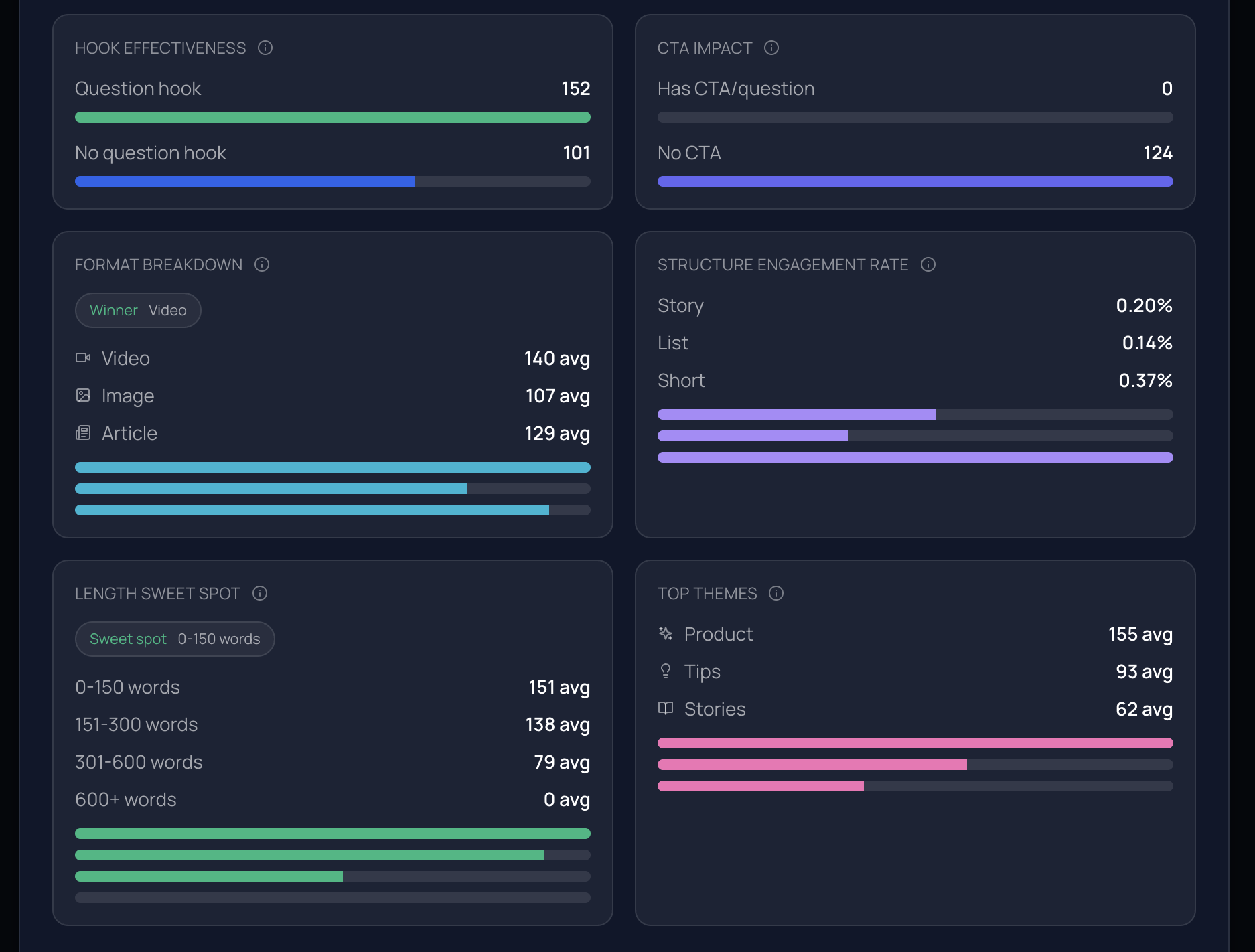
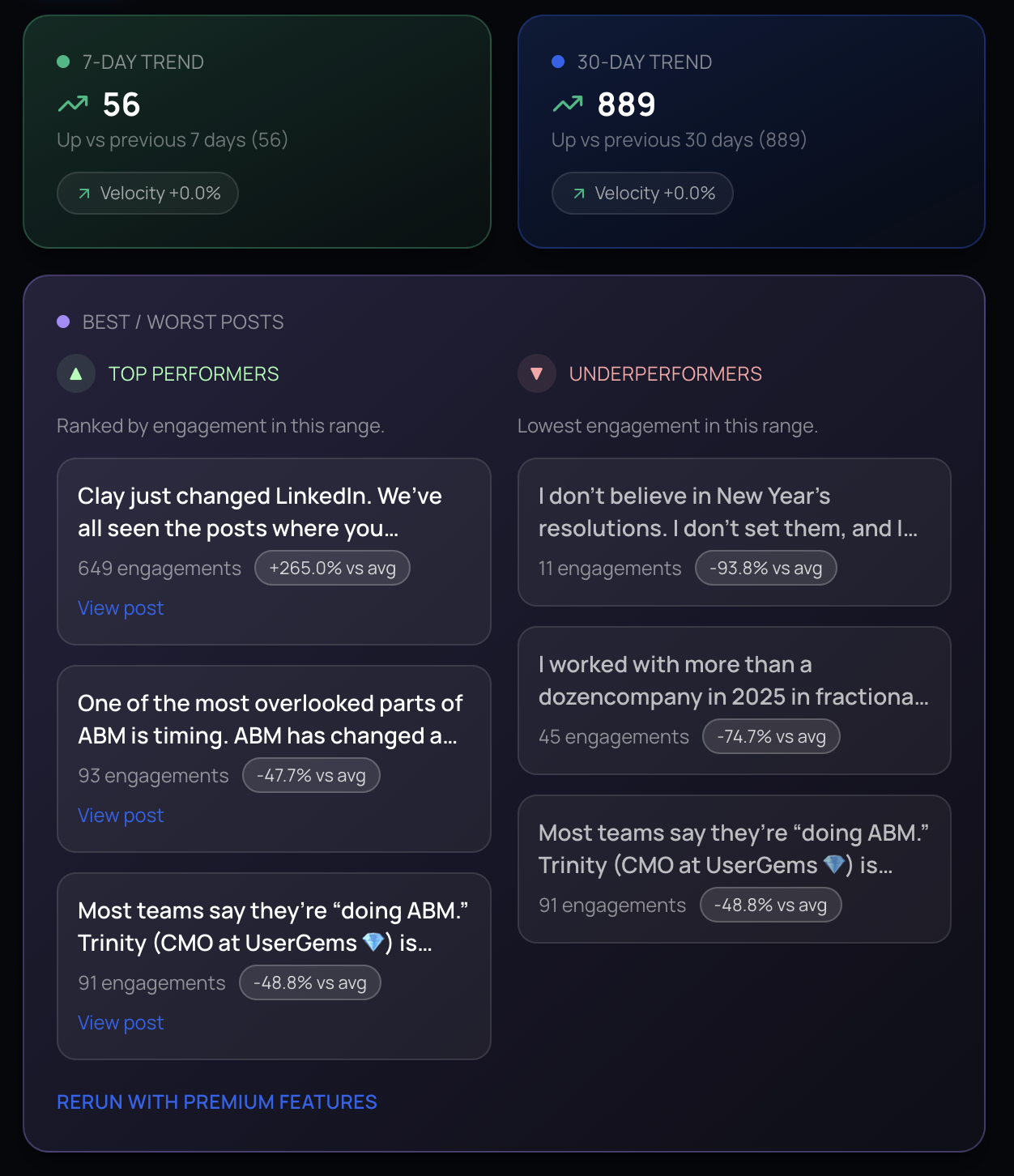
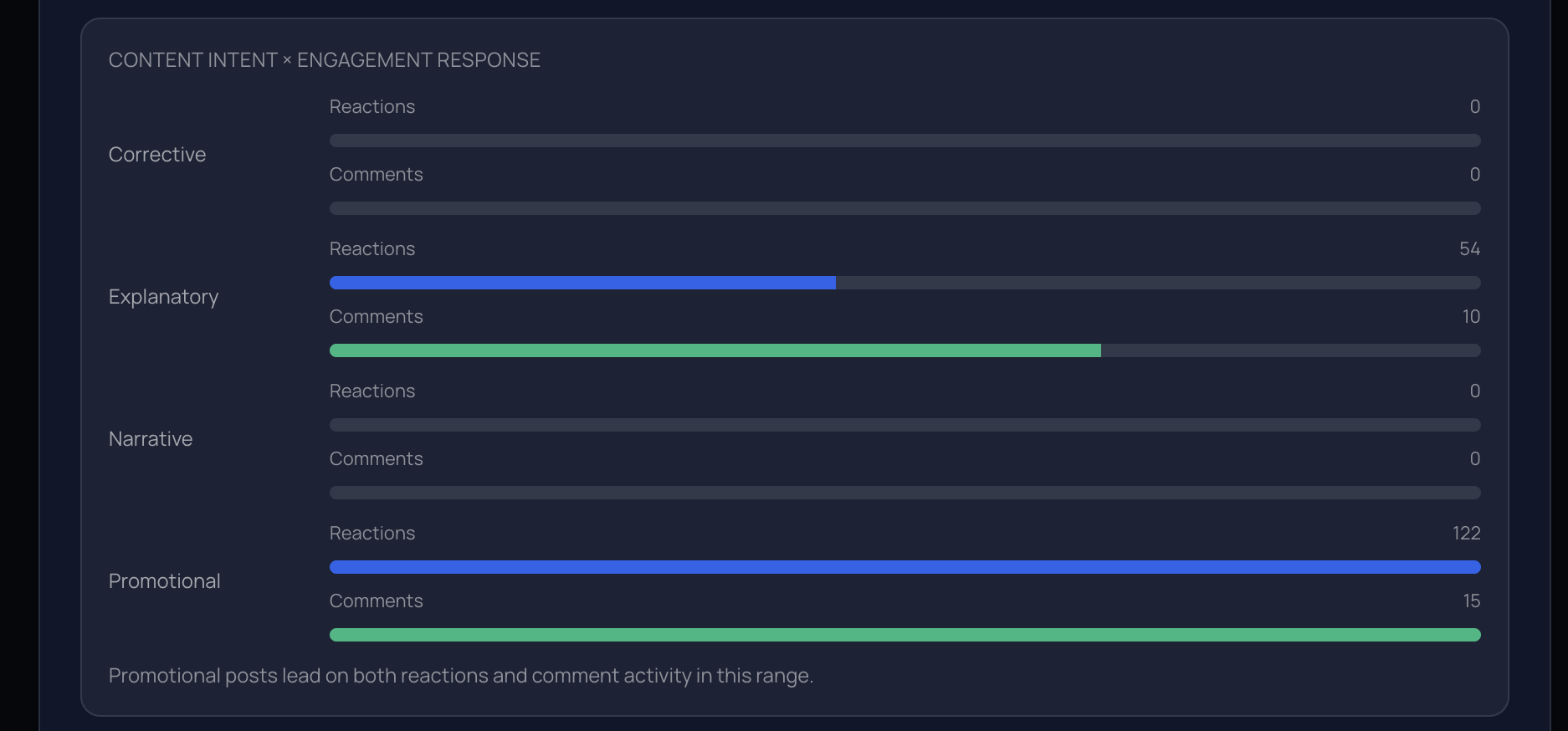
SignalScout breaks down your content's creative mechanics — hooks, CTAs, formats, and structure — so you know exactly what's driving engagement and what to replicate. The Pulse tab shows velocity trends, so you can double down on content when it's gaining momentum.
The five content pillars that consistently drive LinkedIn engagement are: Frameworks and mental models (structured thinking tools, 2–3× average engagement); Data-backed insights (evidence-supported observations, 40–60% above opinion posts); Original research (deep dives with original work, 3–5× typical engagement and the longest shelf life); Problem and solution (specific problems with surprising solutions, high comment discussion); and Contrarian takes (genuine challenges to conventional wisdom, highest comment volume and algorithmic reach). Most effective strategies combine all five in a deliberate distribution aligned to your specific audience and positioning.
The four-step process: First, identify 5–10 content leaders in your space with strong, consistent engagement. Second, audit their last 50 posts — categorize by pillar, calculate average engagement rate per pillar, and note which format combinations generate the highest engagement. Third, identify thematic patterns — what topics appear repeatedly, what positioning themes they emphasize, who they explicitly address as their audience. Fourth, benchmark your content against theirs to identify gaps — which pillars are they using heavily that you're ignoring, and which formats generate 4%+ engagement for them that you haven't tried yet.
For B2B LinkedIn, 2–3 posts per week is the recommended cadence. Consistency matters more than frequency. The algorithm rewards accounts that post reliably on a predictable schedule — posting 5× one week and disappearing for two weeks reliably underperforms a steady 2× per week cadence. The second-highest-leverage activity after publishing is responding to all comments within the first 2 hours, as this signals to the algorithm that the post is generating real conversation and significantly boosts distribution.
By content type: original research generates the highest engagement (3–5× average) followed by contrarian takes (high comment volume), frameworks (2–3× average), and data-backed insights (40–60% above opinion posts). By format, carousels outperform text-only posts for complex ideas that benefit from visual structure. Long-form text posts perform well for personal stories and detailed analysis. Video underperforms on LinkedIn unless it's founder-led storytelling or product demonstrations — unlike TikTok or Instagram, LinkedIn is not a video-first platform and rewards substantive written content.
Optimizing for vanity metrics — likes and impressions — instead of engagement quality. A post with 100 likes and 2 comments is algorithmically and commercially less valuable than one with 30 likes and 15 substantive comments. The LinkedIn algorithm weights comment engagement heavily and amplifies posts that generate discussion. Beyond the algorithm: commenting audiences are reading carefully enough to respond, which correlates directly with higher content recall, trust, and conversion to leads. Design every post to provoke a response, not just passive approval.