Your competitors broadcast their strategy on LinkedIn every day — their messaging shifts, content priorities, audience growth, and market pivots. This guide shows you exactly what to track and how to act on it.
LinkedIn competitive intelligence is the systematic analysis of competitors' public profiles, posts, engagement patterns, and audience interactions to uncover strategic insights about their positioning, content strategy, messaging, and market priorities.
Unlike traditional competitive analysis that relies on press releases and third-party reports, LinkedIn competitive intelligence is primary intelligence — you're observing real behavior in real time: what your competitors publish, how their audience responds, and how their influence is growing or declining.
💡 Key insight: LinkedIn forces companies to show their hand. You can see what they believe is worth communicating, who their audience trusts, how fast their brand momentum is growing, and what market trends they're responding to. This is goldmine-level intelligence — available for free, publicly.
Most competitive analysis happens too late. You read a press release — your competitor already shifted messaging. You see a job posting — they've already hired the team. You notice a content push — they've already built momentum.
When you rely on quarterly reviews and periodic audits, you're always three months behind. Teams that monitor LinkedIn signals in real time see the market moving before others do.
Not all LinkedIn data is equally useful. These five signals are the most reliable indicators of competitor strategy shifts — and the ones most brands overlook entirely.
Publishing consistency signals priority and resource allocation. A competitor ramping from 2 posts/week to 5 posts/week signals a strategic content initiative — often preceding a product launch or market expansion by 2–4 weeks.
Example: Competitor increases posts from 2 to 10 per week. Two weeks later, they announce a new product feature. The signal preceded the announcement.
Format reveals strategic priorities. A shift from text-only to heavy video content signals increased content budget and a move toward product or brand storytelling. Carousel growth signals educational repositioning.
A post with 1,000 reactions but 5 shallow comments has different signal value than a post with 200 reactions and 50 substantive comments. The second indicates real influence with a thoughtful audience.
Key distinction: Measure comment depth, not just count. Thoughtful replies signal genuine influence. Generic one-liners often indicate low-quality or purchased engagement.
Sudden follower growth spikes often correlate with viral content, PR campaigns, or strategic initiatives. A competitor's baseline of 100 new followers/month spiking to 300 tells you something important about what their audience cares about.
When a competitor starts emphasizing different benefits, target audiences, or use cases, they're adapting to market feedback or capitalizing on a trend. Tracking language changes across posts reveals strategic repositioning before campaigns launch.
Example: Competitor shifted from "LinkedIn analytics tool for agencies" to "competitive intelligence for brand teams" — signaling a move upmarket and a larger TAM realization.
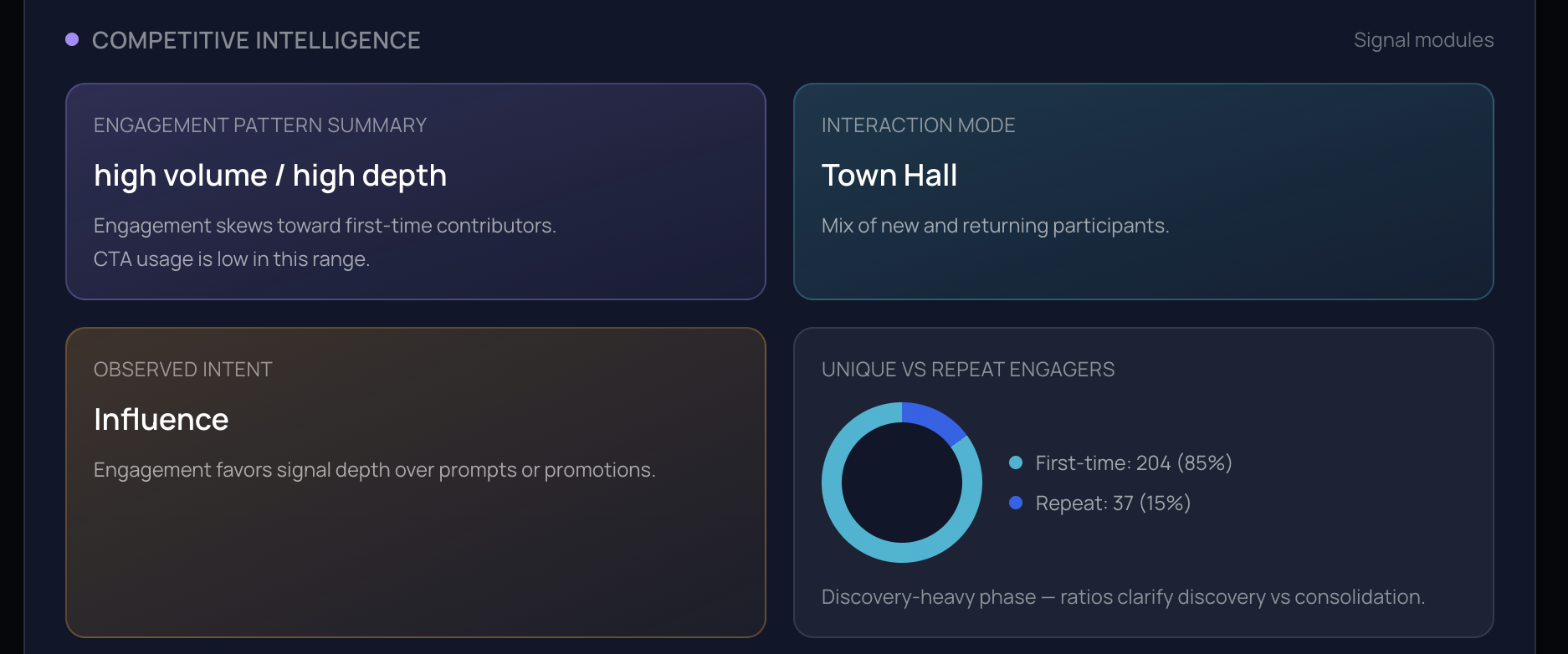
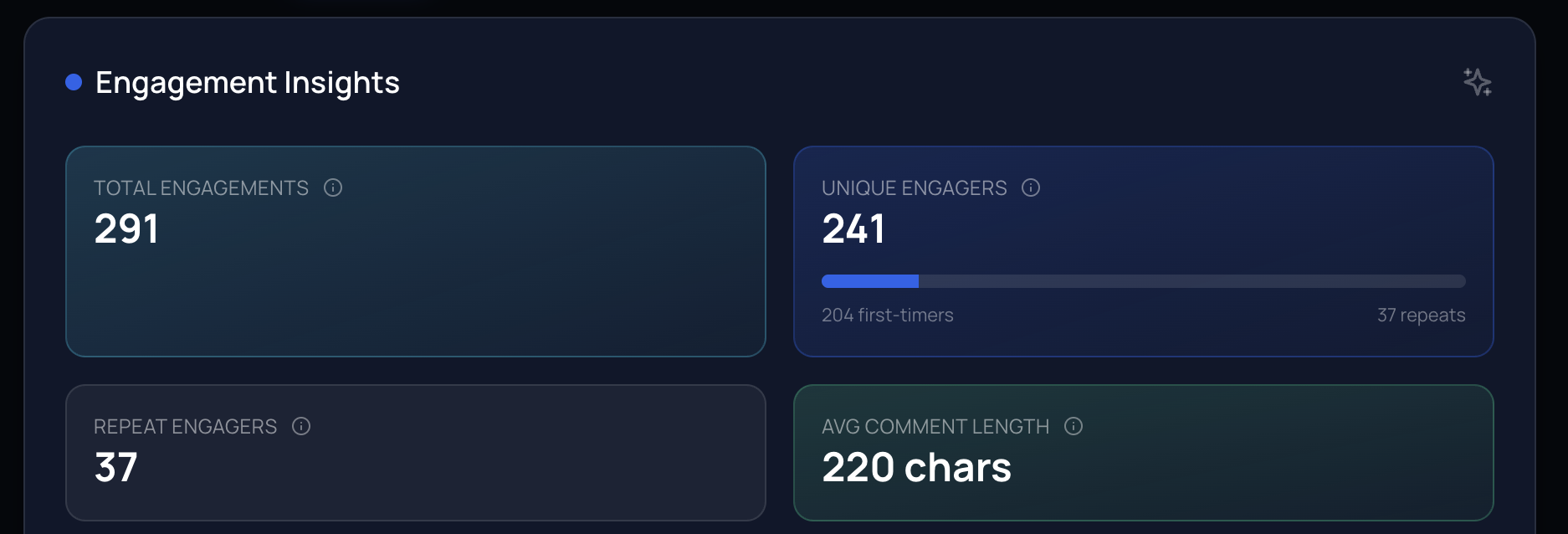
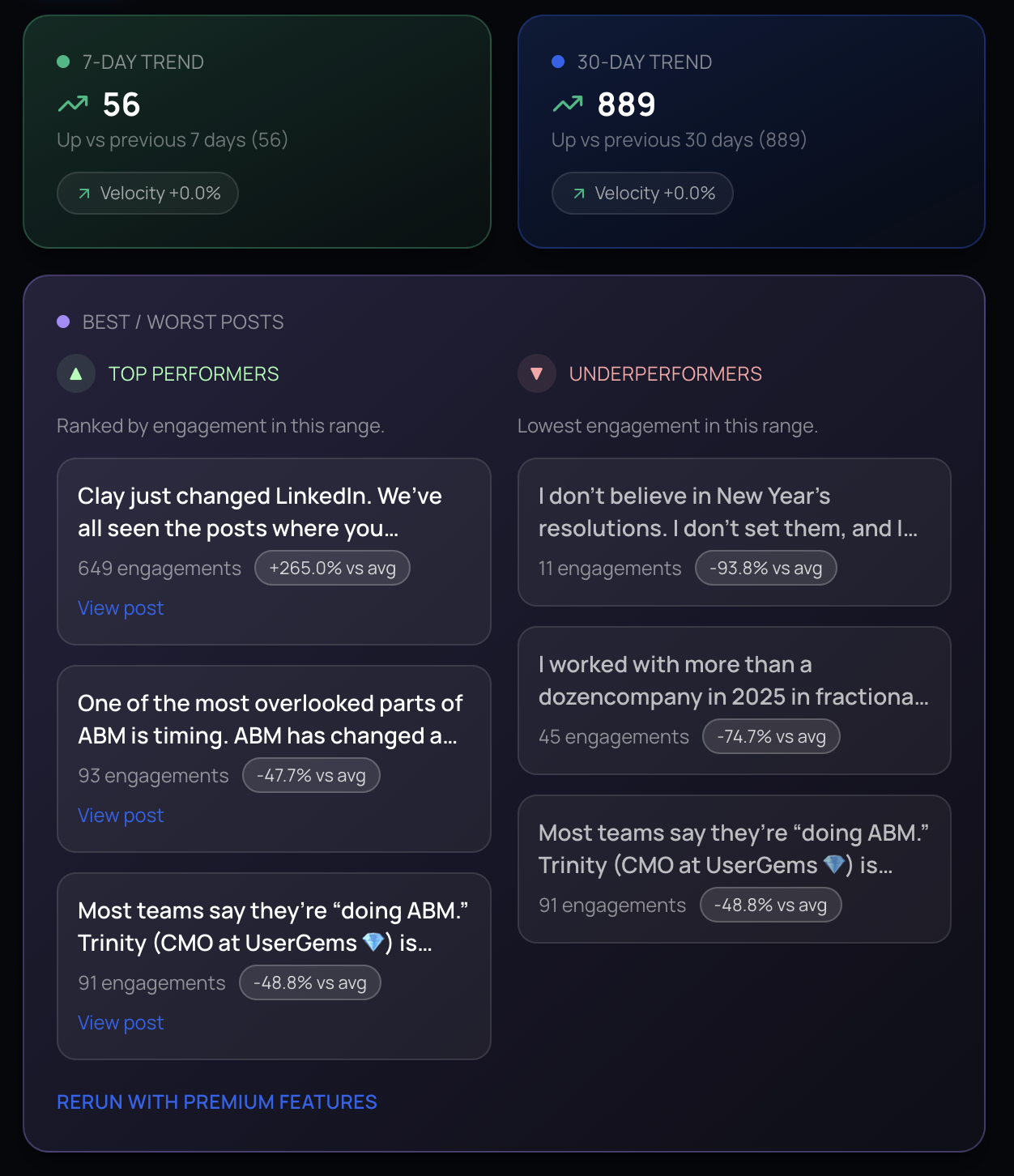
SignalScout surfaces competitive signals automatically. Here's what the Insights tab looks like when analyzing a competitor's LinkedIn presence — unique vs. repeat engager ratios, engagement quality breakdown, and the competitive intelligence layer.
Follow this framework to build a repeatable system for tracking, interpreting, and acting on LinkedIn competitive signals.
Define who you're competing against — not just direct competitors, but anyone fighting for your buyer's attention and budget.
Create a list of 5–10 companies across these categories. This is your monitoring universe.
Manual approach (free): Follow each competitor, check profiles weekly, track metrics in a spreadsheet. Effective but time-intensive — expect 2–4 hours per week for a 5-competitor set.
Automated approach (scalable): Use a LinkedIn signal intelligence tool to automatically scan competitor profiles, track metrics across all competitors simultaneously, and get alerts when patterns change.
Most teams find a hybrid approach works best: automation for metrics and flagging, manual deep dives for strategic interpretation.
Not all signals require equal attention. Prioritize by business impact:
Schedule 30 minutes weekly to review competitive signals and discuss implications. For each signal, ask:
Wait for signal confirmation before committing resources. One competitor doing something once is noise. Three competitors doing it over two months is a trend.
Raw intelligence is worthless without action. For every confirmed signal:
Don't copy — differentiate. Competitive intelligence should inform your strategy, not dictate it. If all competitors are moving toward AI, your differentiation might be simplicity, vertical specialization, or human-first workflows.
A competitor publishing a lot about a topic doesn't mean it's working. Their engagement might be low. Their audience growth might be flat. Pair signal volume with engagement metrics.
One high-engagement post is worth more than ten low-engagement posts. Never act on volume alone.
Seeing a competitor's approach and immediately copying it is reactive and weak. They might be wrong. Their audience and positioning differ from yours.
Use intelligence to understand the landscape and find your differentiated angle, not to mirror what others do.
Not every signal requires immediate response. Sometimes competitors are wrong — they'll kill the feature, messaging will flop, they'll pivot.
Track signals over time. Look for patterns, not single events. If three competitors do the same thing over two months, that's confirmation.
The loudest signal isn't always the most important. Sometimes the most revealing intelligence is what competitors aren't talking about anymore — a feature they stopped mentioning, a market segment they've gone quiet on.
Track presence AND absence. Notice what's disappearing, not just what's appearing.
LinkedIn competitive intelligence is the systematic analysis of competitors' public profiles, posts, engagement patterns, and audience interactions to uncover strategic insights about their positioning, content strategy, and market priorities — using only publicly available data. It gives you real-time visibility into what competitors believe is worth communicating, who their audience trusts, and how their influence is growing or declining.
The five most valuable competitive signals are: (1) post frequency and publishing patterns, which reveal strategic priorities and upcoming announcements; (2) content format mix, which signals budget and content strategy shifts; (3) engagement quality and conversation depth, which distinguish genuine influence from vanity metrics; (4) audience growth velocity, which reveals the effectiveness of their content and campaigns; and (5) messaging and positioning shifts, which expose strategic repositioning before formal campaign launches.
For manual tracking: follow each competitor's profile, check it weekly, and log observations in a spreadsheet. Track posting frequency, content themes, format mix, and engagement patterns (reaction counts and comment volume). For a 5-competitor set, this takes about 2–4 hours per week. For scale, use a signal intelligence tool like SignalScout to automate tracking across multiple competitor profiles simultaneously, getting alerts when patterns change without the manual overhead.
A sudden increase in posting frequency — say, doubling from 2 to 4+ posts per week — typically signals a strategic content initiative. Based on observed patterns, this usually precedes a formal announcement by 2–4 weeks: a product launch, market expansion, a fundraising round, or a brand repositioning. If you notice this in a competitor, start monitoring their content themes closely to understand what direction they're heading.
Yes. Analyzing publicly available LinkedIn content — posts, engagement counts, follower numbers, published articles, and public profile information — is entirely legal. SignalScout uses only public activity data. It requires no login to the target profile, no cookies, and no private data access. All intelligence is derived from data that's publicly visible to any LinkedIn user.
For most teams, a weekly 30-minute review is the right cadence. This gives you enough data points to distinguish trends from noise while staying current enough to respond to meaningful shifts. Monthly reviews are the minimum — anything less frequent and you risk being 6–8 weeks behind on significant messaging or strategy changes. For high-priority competitive situations (a major funding round, a competing product launch), increase to daily monitoring during that period.