LinkedIn is a live intent feed. Every like, comment, and share reveals what founders, buyers, and operators are thinking — months before they announce anything formally. Signal intelligence is the practice of turning that invisible layer into structured, actionable decisions.
LinkedIn signal intelligence is the practice of converting public LinkedIn engagement data — likes, comments, reactions, shares, and follower behavior — into structured, actionable insights about intent, audience composition, and relationship opportunity.
Unlike LinkedIn's native analytics, which tell you only what happened to your own content, signal intelligence works on any public profile and transforms raw engagement numbers into intelligence about who is paying attention, from what company and role, how deeply, and how consistently.
💡 The core insight: Activity ≠ Insight. Everyone looks busy on LinkedIn. Signal intelligence separates meaningful behavioral patterns from vanity metrics — and turns them into next-step decisions your team can actually act on.
A LinkedIn engagement signal is any publicly observable action on LinkedIn content. In isolation, each action is just data. In context — who took the action, from what role and company, how frequently, across how many posts — signals become intelligence.
Traditional LinkedIn analytics answers: "How many people saw this?" Signal intelligence answers: "Who specifically is paying attention, from what company, with what intent, and how warm is that relationship?"
The difference matters because impressions and reach don't predict outcomes. Knowing that a VP of Demand Generation at a target account has engaged with your founder's content 4 times in 30 days — that predicts a conversation.
Signal intelligence typically operates across three layers of increasing depth:
Layer 1 alone is table stakes. Layers 2 and 3 are where signal intelligence delivers decision-ready output.
Not all engagements are equal. Signal intelligence classifies engagement by confidence level — so teams know exactly when to act, and with what urgency.
This person has engaged across 2+ posts AND left a comment AND has a role that matches your ICP. Three overlapping positive signals = relationship-ready intelligence.
Either two or more engagements across posts, or a comment without repeat engagement. Strong enough to monitor actively and activate with a warm approach.
A single engagement is table stakes — it shows awareness, not intent. Track for pattern accumulation over time before activating outreach.
📊 Signal formula: Founder + Relevant industry + Repeat engagement (2+ posts) + Growing company = High-confidence Tier 1 signal ready for immediate outreach.
The SignalScout dashboard translates raw LinkedIn engagement into structured signal intelligence — scoring every engager by tier, surfacing your influence nucleus, and mapping the audience you're actually reaching.
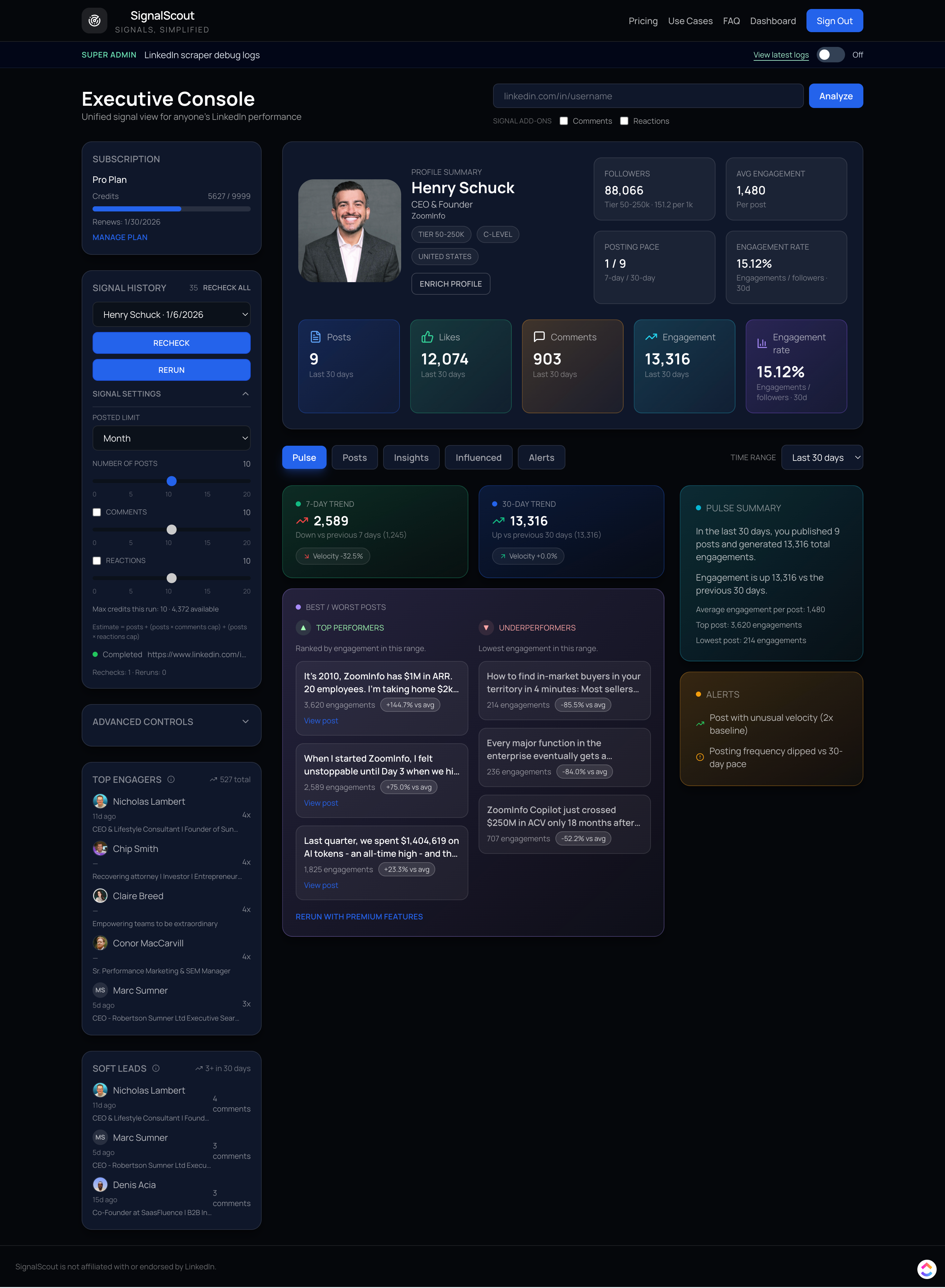
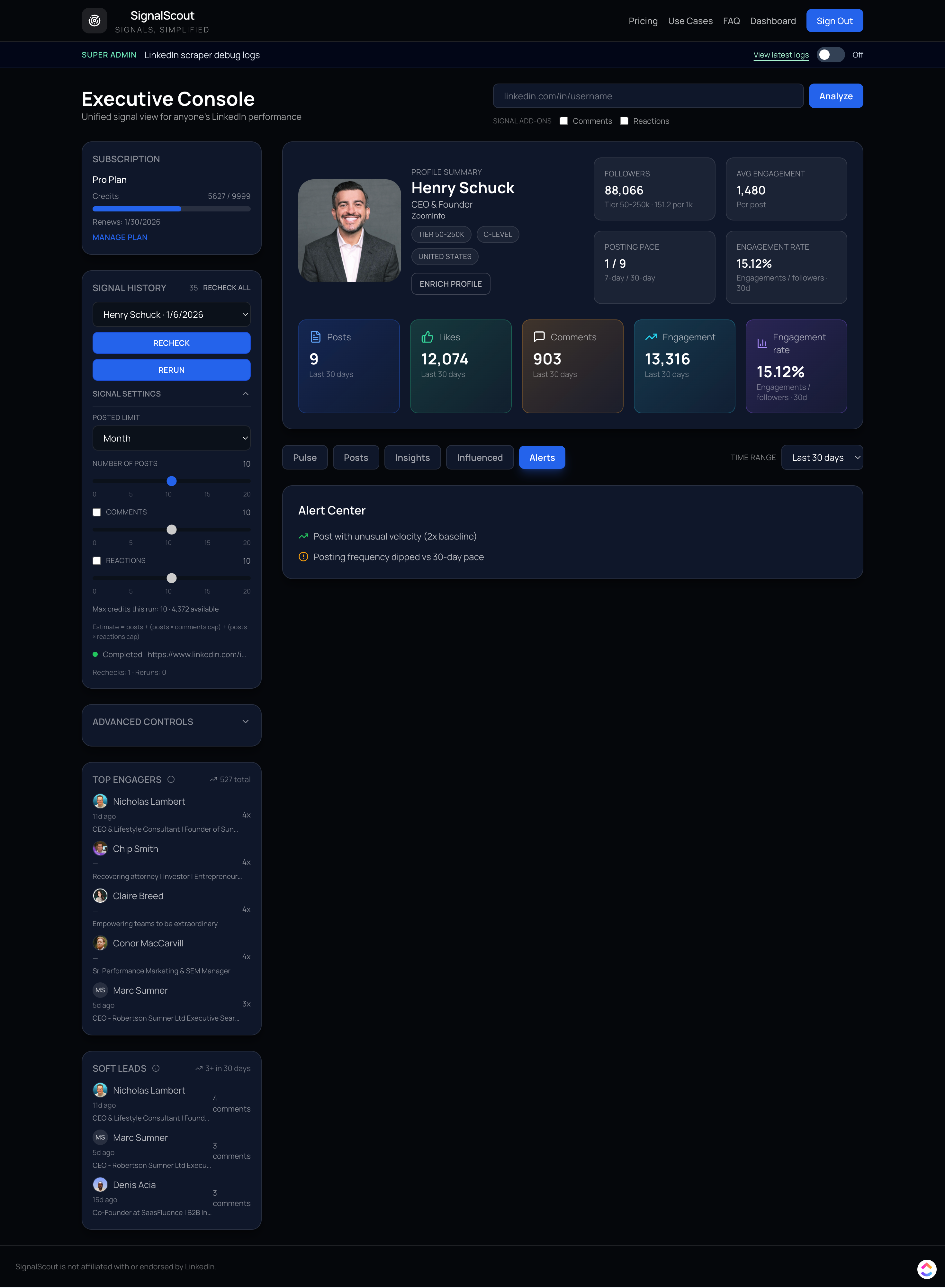
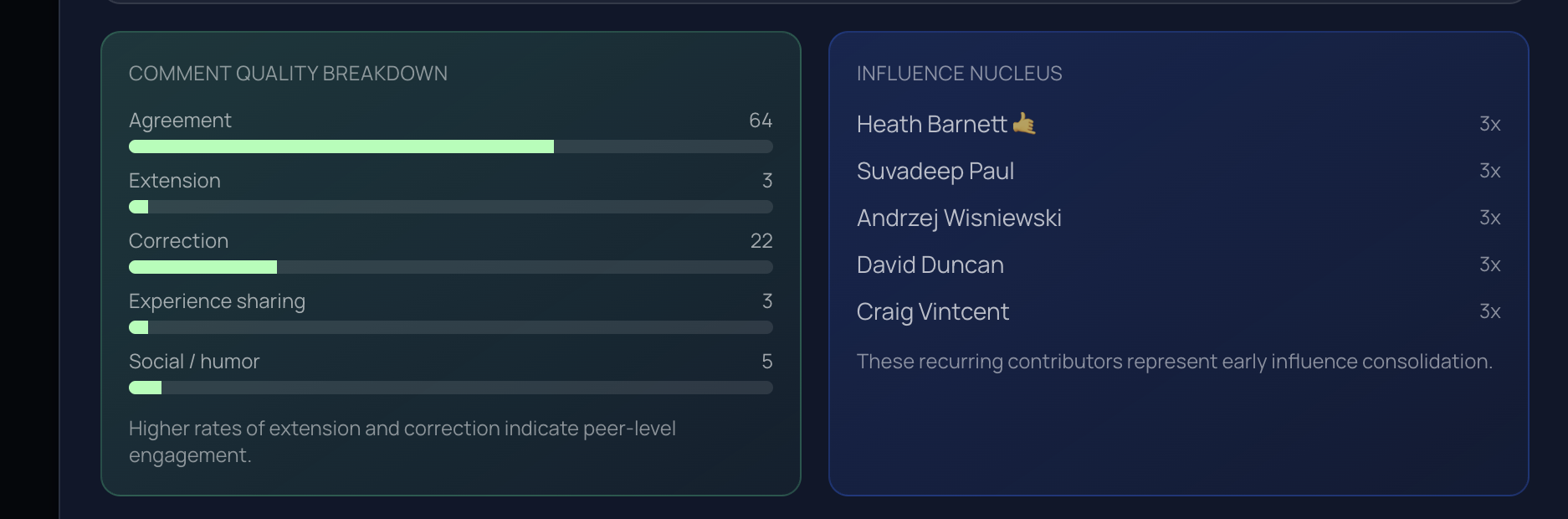
The same signal data powers fundamentally different value propositions depending on who's using it. Here's how three buyer types use LinkedIn signal intelligence today.
Brand teams use signal intelligence to make two historically data-poor decisions: which creators to partner with, and how to benchmark against competitors.
Key use cases:
85% of B2B marketers already use influencer programs. Only 9% say their vetting process scales. Signal intelligence closes that gap.
GTM teams use signal intelligence to build pipeline from founder content — identifying in-market buyers from engagement before they fill out a form.
Key use cases:
Without signal intelligence: content → hope. With signal intelligence: content → signal → pipeline → revenue.
VC firms use signal intelligence to identify pre-raise founders and map deal flow networks before companies are formally fundraising — typically 3–12 months before formal pitches.
Key use cases:
Real example: One VC firm scan surfaced 171 ICP-matched engagers and 79 repeat engagers from 31 posts — representing warm, relationship-ready deal flow that was previously invisible.
| Capability | Traditional Analytics | Signal Intelligence |
|---|---|---|
| Who can you analyze? | Your own content only | Any public LinkedIn profile |
| Engager identity | Anonymous aggregate counts | Role, company, seniority per engager |
| Engagement depth | Total likes and comment counts | Engagement quality, repeat patterns, conversation depth |
| Audience composition | Basic demographic breakdowns | ICP matching, founder/investor/operator classification |
| Competitive analysis | Not available | Full competitor signal tracking |
| Intent signals | Not available | Repeat engagement tiers, pre-raise detection |
| Action output | Reporting only | Prioritized prospect lists, deal flow signals, warm outreach triggers |
LinkedIn signal intelligence is the practice of converting public LinkedIn engagement data — likes, comments, reactions, shares, and follower behavior — into structured, actionable insights about intent, audience composition, and relationship opportunity. It goes beyond vanity metrics (impressions, follower counts) to surface behavioral patterns that reveal who is actually paying attention, from what role and company, with what level of intent, and how consistently. The intelligence works on any public profile, not just your own.
LinkedIn's native analytics shows you aggregate data about your own content — total impressions, demographic breakdowns, and engagement counts. Signal intelligence works on any public profile (including competitors) and reveals individual-level context: who specifically engaged, from what company and role, how many times, and with what depth. This transforms anonymous engagement numbers into actionable intelligence about specific relationships, deal flow, and market opportunities.
Tier 1 (High Confidence): A repeat engager who has also left a comment AND has a relevant role. This is the strongest signal — activate outreach within 7 days. Tier 2 (Moderate Intent): Either 2+ engagements across posts OR a comment only. Monitor closely and plan to activate within 14 days. Tier 3 (Weak Signal): A single like or reaction. This alone is table stakes — track for pattern accumulation over time before acting. The signal formula for maximum confidence: Founder + Relevant industry + Repeat engagement (2+ posts) + Growing company = Tier 1 outreach trigger.
Three primary user types: Brand and influencer marketing teams use it to vet creators, monitor competitors, and identify hidden influencers. B2B GTM and demand generation teams use it to identify in-market buyers from founder content engagement and route warm lead signals to sales before any form is filled. Venture capital firms and investors use it to detect pre-raise founder intent signals — typically 3–12 months before formal fundraising — and map engagement networks for deal flow sourcing.
Yes. Signal intelligence uses only publicly available LinkedIn data — content, engagement counts, follower numbers, and public profile information that any LinkedIn user can see without logging in to a target profile. It does not require login credentials for target profiles, access private messages or connections, use cookies, or have any affiliation with LinkedIn as a platform. All intelligence is derived from data that's publicly visible and publicly intended to be shared.
A founder who consistently engages with a VC firm's partner content is intentionally staying visible to that firm — often 3–12 months before a formal fundraising process begins. Repeat engagement (2+ posts) combined with a founder role and growing company context creates a high-confidence pre-raise signal. This is deal flow that exists entirely outside the traditional warm intro or inbound pitch process — it's sourced directly from behavioral intent data before anyone raises their hand formally.